Attic Mold Remediation in Lakeland, FL
The roofer replaced the shingles Milton tore off in October and said the decking looked fine from above. In spring an insulation contractor went up through the hatch and came down with photos: black streaks on the underside of the decking over both back bedrooms, and insulation that was still damp to the touch six months later. Nothing ever showed on the ceilings below. This site connects you by phone with an independent local provider who does attic mold remediation in Lakeland and across Polk County.
Reading the decking and the insulation from the hatch down
The first visit goes up the hatch with a meter and a light. The crew reads the decking, the rafters or truss chords, and the insulation across the whole attic, not just over the two bedrooms, because wind-driven rain travels along the decking before it drips. They check the ridge and soffit vents, the bath fan ducts, and the air handler and supply trunk if they are up there.
That reading sorts the attic into three groups: decking and framing that can be cleaned in place, insulation that has to come out, and ductwork that is sweating onto the insulation and will wet it again. The scope is written from that, and the roof has to be tight before the work starts.
Leave the attic closed and get the roofer's paperwork together
Do not go up and start pulling insulation, and do not run a fan into the attic. Disturbing wet insulation in a hot attic without containment sends spores down through every ceiling penetration in the house. Keep the hatch closed and the air conditioning running.
Gather the roofer's invoice and photos, the date of the storm, and your insurance claim number if there is one. If a bathroom ceiling or a closet below the attic has a stain, photograph it; that marks where the water ran.
Decking cleaned where it sits, insulation bagged, ducts sealed
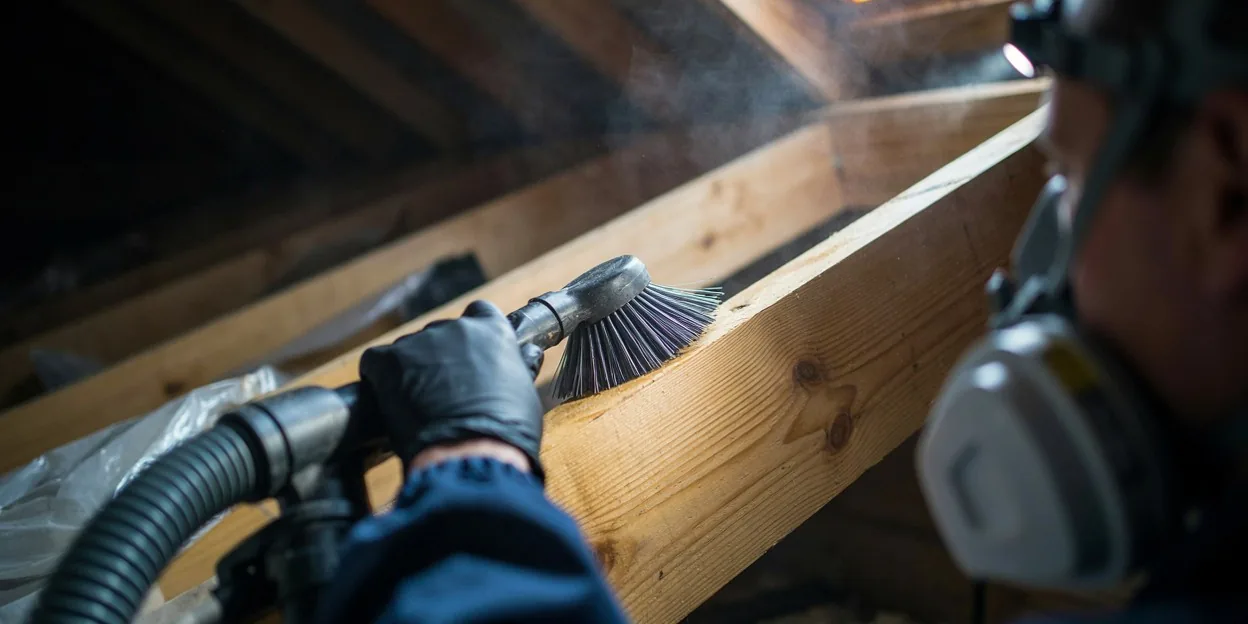
The attic hatch is sealed into a containment and a HEPA scrubber runs the whole time. Wet insulation is bagged and carried out through the containment, never through open rooms. The decking, rafters, and truss chords are HEPA vacuumed, cleaned, and treated with an antimicrobial, and the crew re-reads them before anything goes back. Decking that has gone soft is cut out and replaced with the roofer.
Supply ducts that are sweating get their insulation jacket repaired or replaced, and bath fans that vent into the attic get ducted through the roof or a soffit. New insulation waits until the decking reads dry. A stain on a ceiling below is mold removal from the room side. Growth inside the air handler or the duct liner is HVAC mold cleaning. If the whole house sat wet after the storm, it folds into whole-home mold remediation.
Hurricanes, hot attics, and 38 lakes of humidity
A Lakeland attic in July runs well above 120 degrees, and when a storm lifts shingles and puts water on the decking, that heat does not dry it; it steams it. Milton did exactly that to thousands of roofs on October 9 and 10, 2024, and Irma's eye crossed western Polk County on September 11, 2017, with gusts over 100 miles an hour in the southern part of the county. In between, ordinary afternoon storms find the same lifted shingle or cracked boot every week from June through September.
The other attic problem here has nothing to do with the roof. The air handler and the supply ducts in a 1980s ranch sit in that attic, and cold ducts in wet air sweat onto the insulation all summer. Florida licenses mold remediators as a separate trade under Chapter 468, Part XVI, and the provider represents its own license. Roof repairs and reroofing need a permit from the City of Lakeland or Polk County, and that is the roofer's job; wind damage is often a separate coverage from mold on a Florida policy, so the roofer's photos matter.
Calling about an attic in Lakeland
Have the address, the date of the storm or the roof repair, and what the roofer or insulation contractor saw. Say whether the air handler is in the attic and whether any ceiling below has stained. Call (863) 375-7712.